Loading

HomeThe GEO discovery paradox: why being well-optimised doesn't mean being found
The GEO discovery paradox:
why being well-optimised doesn't mean being found
Picture this scenario: Your marketing team has invested significantly in Generative Engine Optimization. You've refined your website structure, created AI-friendly content, strengthened your authority signals, and built comprehensive topic coverage. Your agency tells you everything looks great. Yet when you ask ChatGPT, Google AI Overviews, or Perplexity for recommendations in your category, your brand is nowhere to be found.
This is the GEO discovery paradox: doing everything 'right' on your website doesn't translate into AI visibility.
At ELCA, we focus on why companies optimise but remain invisible—and what it takes to change that. Most GEO agencies deliver optimisation. We deliver strategic orchestration.
What most GEO approaches focus on
The conventional GEO checklist has become familiar territory: structured content, schema markup, authority signals, topical depth, and citation-rich writing. The underlying assumption is straightforward—if your content is well-structured and clearly authoritative, AI systems will recommend you.
This assumption contains a critical flaw. These elements are necessary but not sufficient. Most GEO efforts focus overwhelmingly on what you control—your own website—while largely ignoring what actually drives AI recommendations.
The evidence: a 30-to-1 visibility gap
Recent research has quantified this problem with striking clarity. A December 2025 study analysed 112 startups, testing over 2,000 queries across ChatGPT and Perplexity. The methodology asked a simple but revealing question: Do AI systems know about these brands? And do they actually recommend them?
The results reveal a massive gap between recognition and recommendation:

Why good optimisation doesn't lead to recommendations
Several factors explain why well-optimised websites fail to achieve AI visibility.

AI discounts self-promotion
Companies assume that structuring their own content well will lead to discovery. But AI models systematically prioritise what others say about you over what you say about yourself. Your perfectly optimised website competes against the aggregated voice of the broader web—and loses.

Companies optimise for the wrong signals
Most companies invest in signals that don't predict AI recommendations, whilst completely ignoring the signals that do. Understanding this gap intellectually is one thing. Executing against it operationally is another.

Each AI platform works differently
ChatGPT, Perplexity, and Google AI Overviews each weigh signals differently. Most organisations treat all AI platforms identically in their strategy—a fundamental mistake that most underestimate.

What others say matters more than what you say
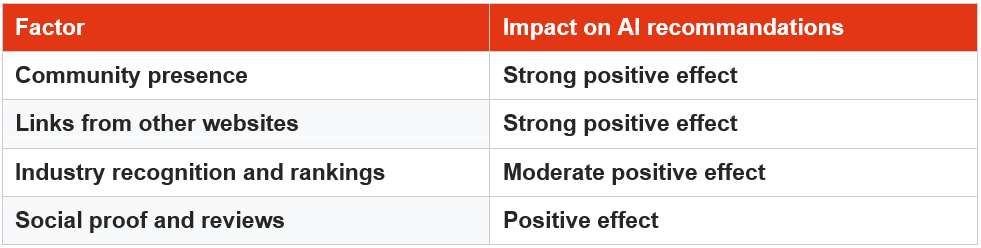
Third-party mentions, community presence, and earned media dramatically outperform owned-media optimisation. Yet most organisations have no strategy for this—or the wrong one. Building genuine external authority requires capabilities that most marketing organisations fundamentally lack. That's where most strategies fail—not at the insight stage, but at the execution stage.
The research's practical takeaway is counterintuitive: don't optimise for AI discovery directly. Build your external authority first, and AI visibility will follow.
What actually drives AI recommendations
If website optimisation alone doesn't drive visibility, what does? The research reveals a clear pattern:
What works
What doesn't work
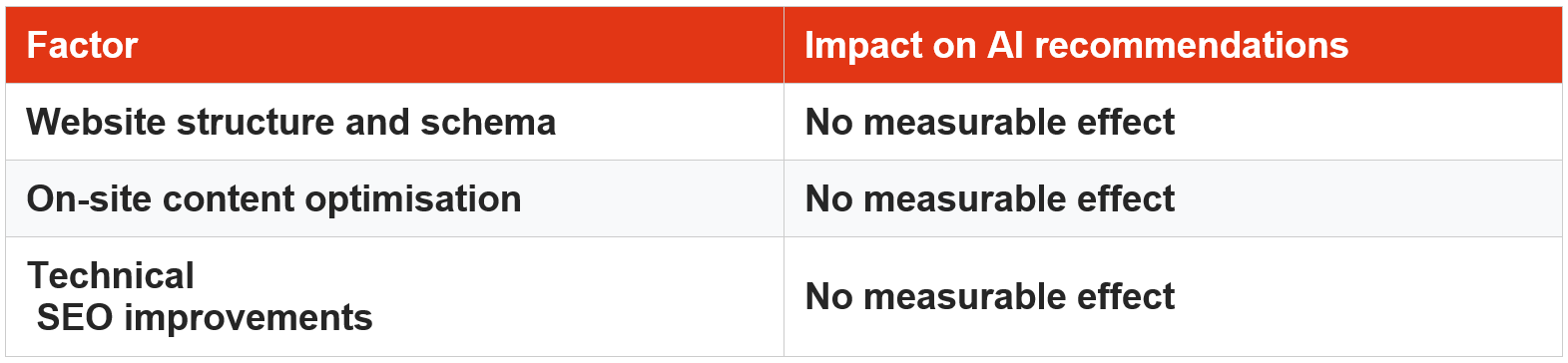
The execution gap
The gap between understanding this problem and actually solving it is where most companies stall. Many executives now understand the insight intellectually—but lack the operational capability to translate it into results. This requires strategic capability that most organisations simply don't have in-house.
A note on this research
This study focused on 112 technology startups. Patterns may differ for publishers, e-commerce, or B2B services. However, the core finding—that website optimisation alone doesn't drive AI recommendations—held consistently across both AI platforms tested. This is the strongest empirical evidence to date that AI visibility requires more than on-site work.
From insight to results
Most companies see the problem but can't execute the solution. Strategic orchestration is where external guidance matters most.
Roger Zimmermann
Expert in Digital Marketing
Meet Roger Zimmermann, our Expert specializing in Referencement and Digital Marketing.
Sources
1. Sharma, A.P. The Discovery Gap: How Product Hunt Startups Vanish in LLM Organic Discovery Queries. arXiv:2601.00912 (December 2025)
2. Aggarwal et al. GEO: Generative Engine Optimization. IIT Delhi Research
3. ELCA GEO Optimization Framework. www.elca.ch