What Actually Survives
Rethinking the Document in the Age of AI
Everyone wants to know whether their systems are “AI-ready.” But before choosing a model, organizations need to ask a more fundamental question: are the documents underneath actually reliable?
In this expert note, adapted from a talk given at the SPS Executive Event – Future of the Document, Vincent Dupin, Head of Business Line IIM/ECM Solutions at ELCA, explores what a document really is, why it is not the same as a communication, and why AI makes source documents more critical, not less. From template governance and long-term archiving to institutional registries and verifiable credentials, he outlines what banks and insurers in particular need to put in place today.
Introduction
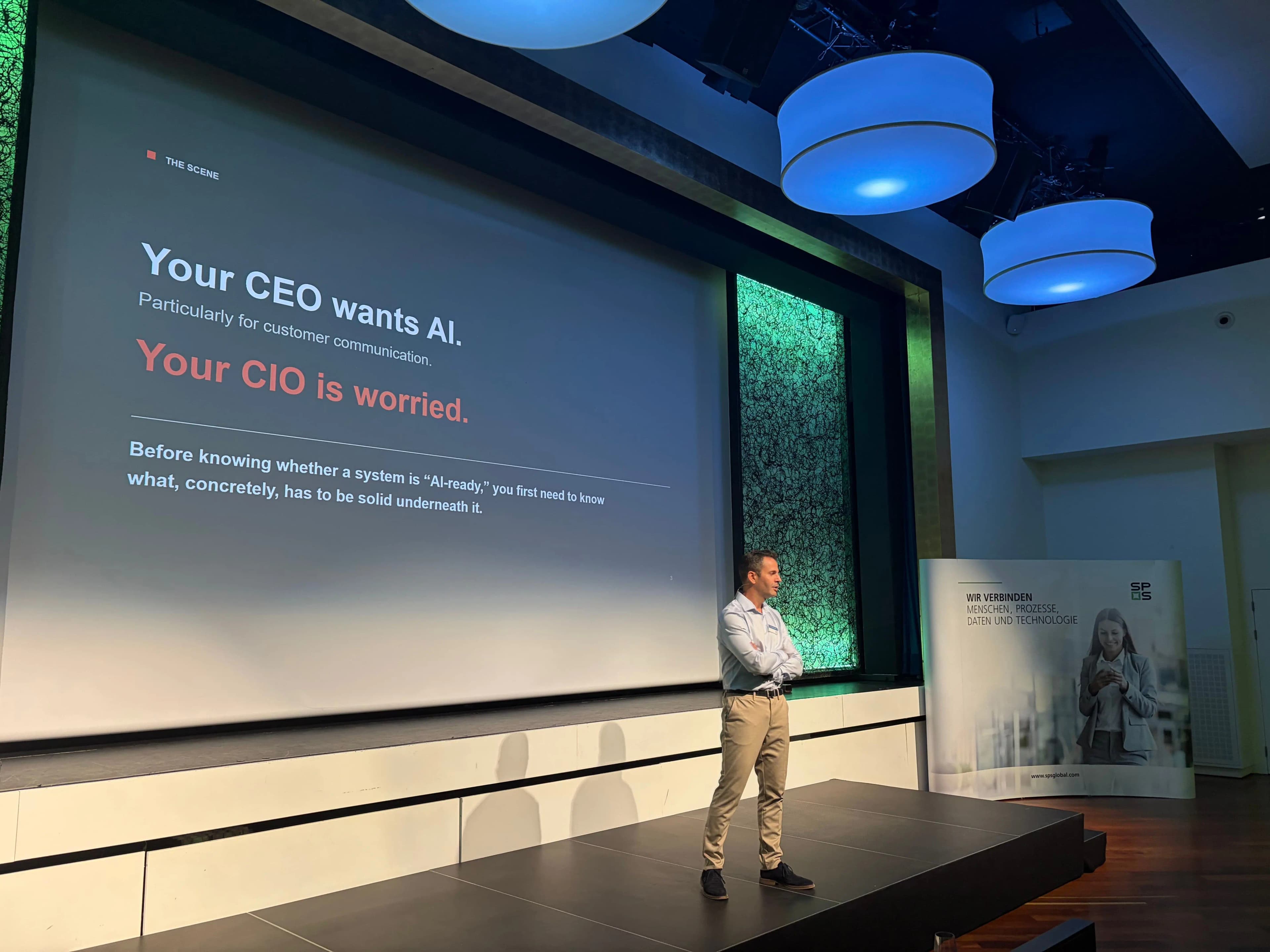
The same scene plays out in many organizations today. The CEO asks the CIO to use artificial intelligence to optimize processes — particularly customer communication. The CIO, for their part, is asking a quieter question: is my system actually ready for this?
That question isn’t resolved at the level of which AI model gets chosen. An AI that generates or explains a customer communication is, in reality, drawing on documents: policies, regulations, templates, files. If those documents aren’t solid, the AI will amplify their flaws, faster and at a far greater scale than any human ever could. Before knowing whether a system is “AI-ready,” you first need to know what, concretely, has to be solid underneath it.
Before getting there, I want to show how AI is already transforming the customer relationship.
AI Is Transforming the Customer Relationship
Two shifts are meeting today. The first is driven by AI. The second started long before it.
The first: AI can now read and analyze documents that were very often never read at all. Think of an insurance policy — forty pages, legal wording, one clause referring to another. We signed it. Let us be honest: we did not read it.
What AI brings here is genuine progress: we can now ask a question and get an answer taken from that document. Am I covered in this specific case? We can even compare it with a competing policy, beyond price alone. For the first time, the customer is able to take back control. But notice what happens at the same moment: the document is finally being used, and nobody is checking it. Which raises the question: can we be sure these documents are reliable? And who answers for them?
The second: the customer communication channel changed, in three steps.
In the paper era, a document was printed and posted. One detail matters here: both parties kept a copy. The customer had one, the company had one. Each side physically held its own proof.
Then came digital transformation. New channels appeared — a mobile app, a customer portal, email. Information is now shown live in the app, and that is the most visible change. But be careful: the document is still the proof. It did not lose that role. It is archived by the issuer, and the customer can still download it. The difference is that almost nobody does.
The third step is happening now: we no longer navigate menus, we no longer fill in forms. We talk directly to an AI: “I want to report a claim,” “show me how my investments performed last month,” “can you check the latest invoice?”
The document is still the proof. We simply stopped taking it, and stopped reading it. Keep this in mind: we will see later that the movement continues, up to the point where the document itself disappears.
And that leads to a question that sounds almost too simple to be worth asking.
What is a document?
Document and Communication: A Distinction We No Longer Dare to Make
“Document” comes from the Latin documentum, derived from docere, “to teach.” Originally, a document was a lesson, a piece of evidence meant to instruct — proof and instruction were the same word. A document was never just a plain carrier of information; it always carried an evidentiary function.
Here is a more operational definition: a document is something deliberately fixed, so it can be relied on later, by someone who wasn’t present when it was created — without its author there to explain it.
Three elements matter here:
- Fixation: the content stays the same when you come back to it.
- Referenceability: you can retrieve the exact same thing later.
- Deferred reliability: it bridges a gap, of time or trust, between when something was decided and when someone needs it.
I’d add a fourth criterion, the one that matters most today: accountable authorship. A document only earns the right to be relied on later if someone — a person, or a governed process — genuinely stands behind its accuracy. This doesn’t require a human to re-read every copy: when a bank sends out a million identical statements, what matters is that the template used to generate them was validated, and that someone remains accountable for it over time. That authorship isn’t earned once and for all — a template validated five years ago and never reviewed since has quietly stopped being “authored,” even though every document it produces looks the same.
This definition connects, without claiming to reinvent it, with the ISO 15489 standard on records management.
The essential point: a document is something that stays fixed, retrievable, and backed by an accountable author.
This definition forces a distinction too rarely made with any clarity: a document is not a communication. A communication — a chat message, a notification, a reminder — is optimized for the exact opposite: timely, suited to the moment, disposable by nature. Its job is done the instant it’s read. A document’s job often only begins once no one is reading it anymore.
A document is almost always delivered through a communication: the contract arrives by email, the statement by notification. The communication is the vehicle, the document is the cargo. But the two don’t follow the same rules — and here, I think, is the most concrete consequence of this distinction: documents and communications shouldn’t be managed by the same solutions, or the same teams. These are two disciplines with opposite success criteria; conflating them means unknowingly applying one’s standard to the other.
It’s the first of these categories I want to talk about here — documents, proof, what has to survive later scrutiny.
The Chain of Arbiters: Who Must a Document Survive?
If a document exists to be invoked later, the question is: by whom? There isn’t one answer, but a chain. A regulator writes the rule — in Switzerland, FINMA requires traceability of banking documents. Sometimes the rule comes straight from the law, such as the statute-of-limitations periods set by the Insurance Contracts Act (LCA). Either way, nobody ever looks at one specific document. An auditor checks, periodically, by sampling, whether the process was followed. And, rarely, a judge examines whether the content actually proves what someone claims it proves.
A document’s real rigor is set by the toughest arbiter it could face — not the most likely one. An ordinary bank statement, read by almost no one, still has to withstand a courtroom it may see only once in ten million cases. This is the essential point: generating a document should never target its most likely reader, but its ultimate purpose — being able, if necessary, to serve as evidence before a judge.
AI Changes the Game, But Not in the Way You’d Think
Let us come back to where we started: nobody reads the document anymore. You might conclude that it matters less than before. The opposite is true.
Let us be precise about what AI does, and what it does not do: it reads the document, it reports back — but it does not check it. It trusts it.
And an AI’s answer is not a document — it’s a communication. Generated on the spot, disposable by nature — right where it belongs. What follows is a requirement, not an option: a generative AI must not invent anything. It has to rely on verifiable sources — specifically, documents that are fixed, referenceable, backed by accountable authorship.
An underestimated consequence: the quality of source documents becomes even more critical — and their readability by AI becomes a requirement in its own right. The human reader who would once have noticed an inconsistency has vanished from the loop; the error now silently propagates to thousands of customers, with the same confidence each time.
This comes back to authorship: for documents generated through customer communications management (CCM) solutions, properly managing the templates used to produce them becomes essential — who reviews them, how often, who remains accountable for their accuracy over time. There’s an emerging discipline here, at the intersection of document governance and AI architecture: a source document needs an identified owner and explicit version control, or an AI may keep citing a version long since corrected in the system, unnoticed — until the day someone has to explain, before a regulator, exactly which version produced which answer.
What This Actually Requires
I propose six workstreams to address this — not in order of ease, but by active risk and dependency between them.
Access governance
Classifying a document and defining who can access it didn’t start with AI, but AI acts as a ruthless revealer of existing flaws: it can retrieve and cite, in a split second, a document the person asking should never have been able to see.
Document template governance
A validated template never reviewed again quietly loses its authorship. This means naming an owner per template, defining a review cycle, and keeping explicit version control.
Legal authorship
A qualified electronic signature identifies a person; a qualified electronic seal identifies an organization for documents generated in bulk. The distinction already exists in law — few organizations use it as a deliberate design choice.
Formatting and format
An AI splits a document into fragments to search it; information scattered across many pages risks never being retrieved together. Format must guarantee fixation over time — PDF/A exists for that — but even normalized this way, an untagged PDF remains hard for a machine to query reliably. The common fix is reconstructing structure after the fact; an alternative is generating a structured derivative alongside the document from the start — provided clear traceability back to the authoritative document is kept.
Accessibility
The PDF/UA standard requires structured, tagged content for assistive technologies — the same tagging very largely serves an AI’s need to read a document reliably.
Retention
An evidentiary document often has to remain usable for a precise legal period. An electronic archiving system compliant with ISO 14641 is not enough on its own: what has to withstand a judge is the entire document process upstream, not just the final archive. Signatures and seals expire too — long-term validation exists to keep a document’s authorship alive beyond its original certificate.
Overall
One last point, cutting across all six: they don’t scale the same way. A one-off contract can absorb manual review; a statement generated by the million cannot — rigor has to be built into the process itself.
When Proof No Longer Needs a Document: The Rise of Institutional Registries
Dematerialization sometimes goes further than changing a document’s medium: a document isn’t even necessary anymore, once an institutional registry holds authority in its place. Take property in Switzerland: you don’t own a house because you’re holding a deed — you own it because your name is in the land register. Lose the deed, and nothing changes; your ownership is untouched. The same logic applies to shares: if you own stock today, you likely don’t hold a paper certificate for it — your ownership lives in the depositary’s register, and that register is what counts, not a piece of paper you’d have to dig out of a drawer.
The Swiss motorway toll sticker offers an even more radical example: with the e-vignette, the physical sticker no longer exists. Proof of payment lives only in a national registry, verified automatically. The confirmation email received is just a communication, not a document.
But not every kind of proof lends itself to a central registry: building one requires a single authority, largely reserved for public administrations. For a private company, or multi-jurisdictional situations, this is often difficult, costly, sometimes impossible. This is where a new type of document becomes genuinely interesting.
Verifiable Credentials: A New Type of Document
There exists a type of document that carries the proof of its own authenticity within itself, without relying on a central registry: it depends only on a lightweight trust infrastructure that attests who has the right to issue or verify, without ever knowing the content. It’s called a verifiable credential. The Swiss e-ID, issued exclusively by the Confederation, is its most visible example.
The Confederation carries this infrastructure and offers a default wallet, swiyu — but companies, too, can issue their own credentials on the same infrastructure, and offer their own wallet. Two potential, not-yet-built use cases illustrate this in Switzerland: on the banking side, a KYC attestation already verified by one institution, which could become reusable elsewhere without starting from scratch; on the insurance side, the private liability insurance certificate a tenant today has to obtain separately for a landlord — a case where no registry allows direct verification, and where a verifiable credential could fill that gap.
A verifiable credential meets our four criteria — in a sense, better than most documents today:
- Its authorship is structurally enforced, not merely asserted
- Compared to a standard PDF, it offers real freshness (checkable at the moment of presentation)
- Selective disclosure (proving one fact without revealing the rest)
- Simple verification, and native machine readability
None of this makes the PDF obsolete overnight. But it’s an opening toward a document natively designed for a world where the reader, increasingly, is no longer a person.
Conclusion
The CEO is right to ask for AI. The CIO is right to worry. But the real gap between the two doesn’t come down to AI capability.
It comes down to this: documents and communications aren’t the same discipline. A document must be designed around its toughest possible arbiter. AI doesn’t replace source documents — it makes them more critical. And more broadly, proof itself sometimes leaves the document to settle into institutional registries — a movement the verifiable credential answers differently, remaining a document, but one that carries the proof of its own authenticity within itself.
The CIO’s question isn’t resolved at the level of which AI model is chosen. It’s resolved underneath, at the level of the documents themselves. In Switzerland, few sectors stand to gain, or lose, as much from this as banking and insurance — two worlds where the document has always been the foundation of trust, long before AI entered the picture.
So I’ll end with a question, rather than a conclusion: before asking what AI can write for you, do you know, today, which of your documents still have someone standing behind them — and which have quietly, silently, stopped having one?