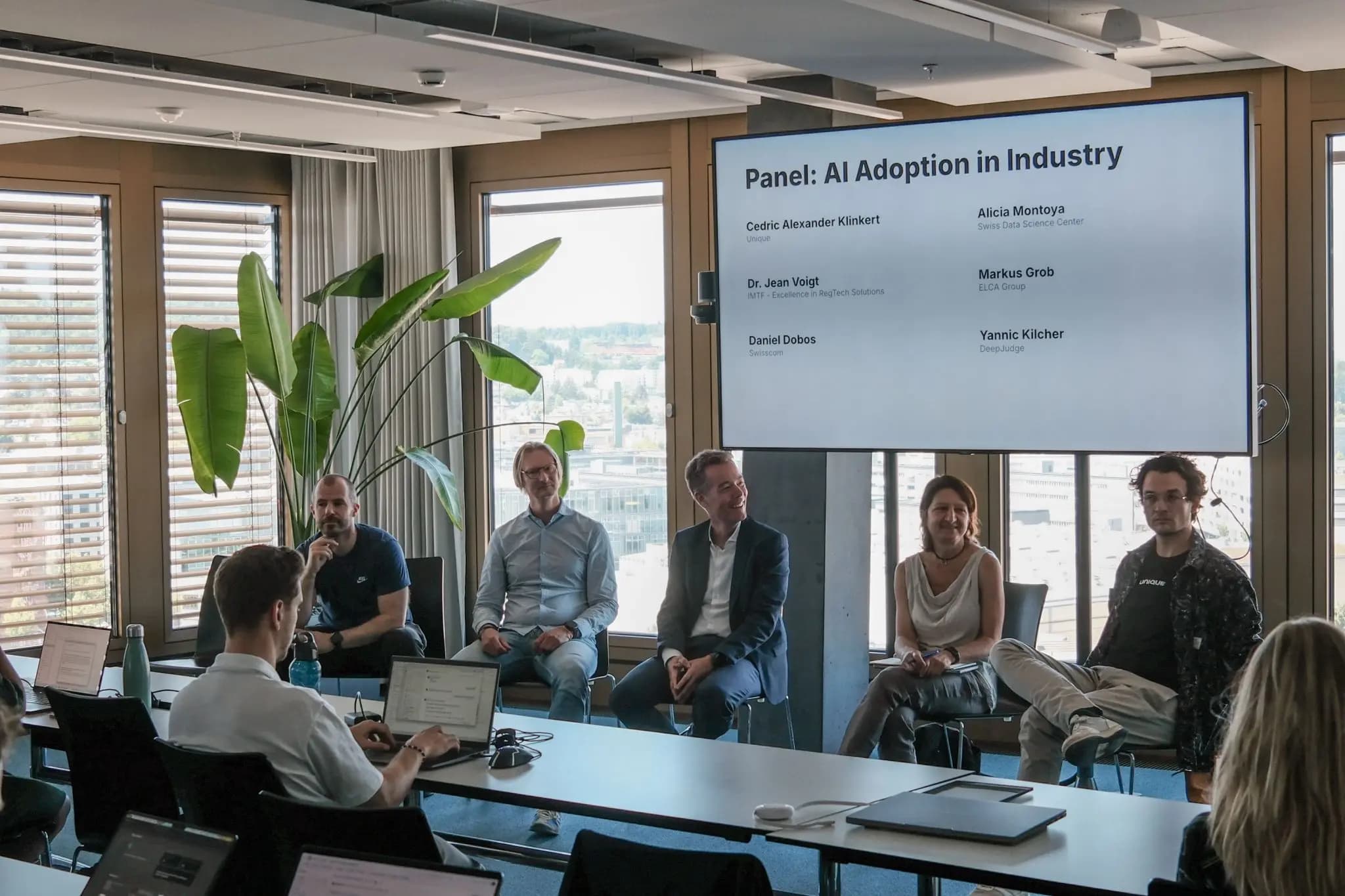
Insights from Panel-Discussion “AI Adoption in Industry”
At the ETH AI Center in Zurich, a panel of practitioners came together to discuss a topic that is currently on the agenda of almost every executive: how to translate AI potential into real business impact. The exchange between industry experts quickly made one thing clear: the gap between successful AI initiatives and failed ones is rarely technical. Our Head of Data, Analytics & AI Markus Grob (ELCA Group) was invited to this panel together with Yannic Kilcher (DeepJudge), Alicia Montoya (Swiss Data Science Center), Jean Voigt (IMTF), Cedric Klinkert (Unique). Their shared perspective provides a grounded view beyond the current hype cycle.
One statement particularly resonated with the audience: “If nobody complains, it’s probably working.” While at first glance this sounds counterintuitive, it highlights a core principle of successful AI - true value often comes from seamless integration rather than visible sophistication.
1. Seamless integration into workflows
AI systems create value when they disappear into existing processes. In many organizations, initiatives fail because they introduce friction instead of removing it. Users are asked to change habits, switch tools, or adapt workflows, which significantly slows down adoption.
In contrast, successful deployments embed AI capabilities into the systems people already use. Document processing, decision support, or automation are integrated so deeply that the user interacts with the outcome, not with the technology itself. This is where AI becomes a true productivity multiplier.
2. Measuring what truly matters
Another key insight discussed at the panel was the challenge of measuring AI adoption correctly. Traditional dashboards often paint an incomplete picture. As one participant highlighted: “A metric only tells you what it was built to see.”
In modern architectures, the most advanced uses integrate AI with API in their daily routines. If the AI adoption dashboard measures only UI driven usage, then it leads to misleading conclusions, such as underestimating adoption or overestimating engagement.
For executives, this means that KPI frameworks need to evolve alongside technology. Measuring value creation requires understanding how AI is actually embedded into processes, not just how often a user logs into a system.
3. Driving adoption through advocacy
Metrics alone do not drive adoption. One of the most powerful signals discussed during the panel was user advocacy. As stated: “If somebody is really happy with something, they’re going to talk.”
This informal diffusion mechanism often outweighs structured rollout strategies. When users actively recommend a solution to colleagues, adoption accelerates naturally across teams and departments.
Organizations that succeed with AI actively encourage this dynamic by focusing on user experience and tangible benefits rather than feature completeness.
4. Creating value across organizational levels
Another recurring theme was the importance of addressing different stakeholder groups. AI initiatives often succeed at operational levels but fail to gain traction at executive level.
The panel discussed several examples where decision-makers were not directly exposed to the value of AI solutions. Without this connection, even successful projects risk losing momentum.
This highlights the need to design use cases that resonate across all levels -from analysts who interact with data daily to executives responsible for strategic direction.
5. Thinking long-term
Finally, successful AI initiatives require a long-term perspective. Many organizations expect immediate results, but meaningful impact often takes 12 to 18 months to materialize.
As highlighted during the discussion: “It’s a continuous journey. Things are changing quickly - you can’t do things once and expect them to be done.”
This continuous evolution reflects the nature of AI itself. Models improve, costs change, and regulations evolve. Organizations must therefore build capabilities rather than isolated projects.
For executives, the implications are clear. AI success is not primarily about selecting the right model but about building the right organizational conditions.
At ELCA, we support clients in embedding AI into their core processes, ensuring adoption across levels and delivering sustainable business impact. We invite you to contact our experts.