
Citizen Development Without Chaos with Microsoft Power Platform
How business teams can build their own Power Platform apps and automations, with the right support around them
Ask a room of office workers whether they could build a small app to track their team’s requests, and most will say no. Yet many of them already fix their own work every day with clever spreadsheets and workarounds. Often the missing piece is not the tool but a colleague who shows what is possible and encourages them to try. That is where Power Platform adoption succeeds or stalls. Governance can set boundaries, but it can’t create makers. That takes people, patience, and a community that keeps them going.
Adoption works best when people and learning take priority over technology. The approach described in this article is how we would set it up, and it can be adapted to most organizations rolling out Power Platform to business users.
What is citizen development?
Citizen development means that employees outside IT, in teams such as finance, HR, operations or customer service, build their own apps, forms and automations. They use low-code tools such as Microsoft Power Platform, where visual design and configuration replace most programming. The people who know a process best can therefore improve it themselves, without waiting for a development project. In this article, we call them makers.
Citizen development does not replace professional developers or the IT function. It works within boundaries set by governance, with a central team that supports makers and takes over when a solution becomes business-critical or too complex.
Why this approach
Low-code tools are often introduced with a platform rollout and a set of rules, then left to spread on their own. The usual result is that a few technically confident colleagues build everything and become a bottleneck, while everyone else never starts because the tools seem meant for developers. Neither delivers what citizen development promises: business teams solving their own problems with solutions they build and maintain themselves.
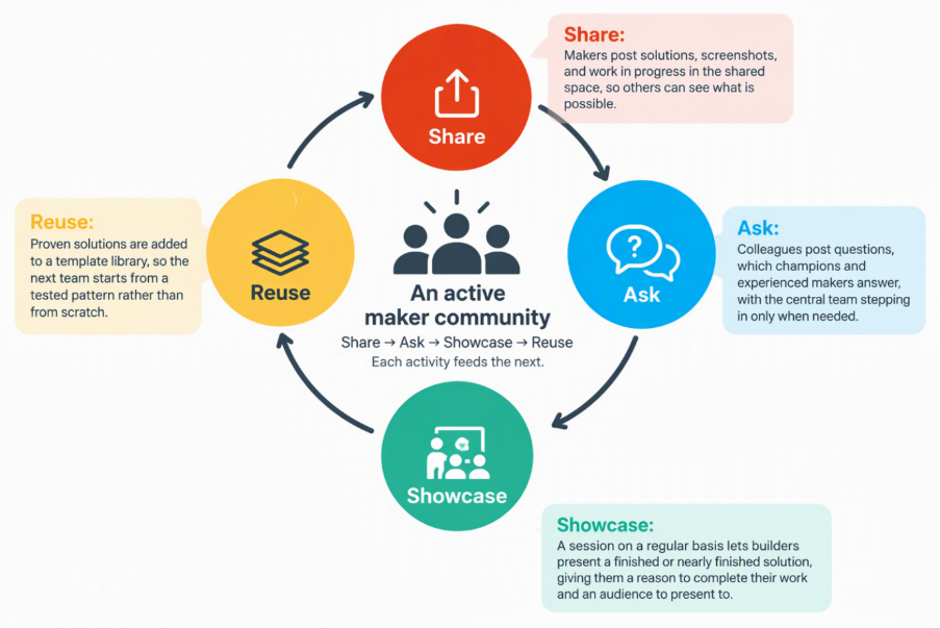
A champion network and a community address these problems. Champions spread knowledge through trusted colleagues, reaching people a central team cannot. The community keeps momentum going after initial training, when most adoption programs quietly fade. People also build and maintain solutions they understand and feel ownership for, which is the foundation governance depends on.
Building a sustainable maker community takes more than training and technology. The following five steps provide a practical approach, starting with identifying the right champions and creating early successes, then helping newcomers build their skills and connecting them through an active community. Finally, measuring progress and continuously improving the approach ensures that citizen development remains valuable over time.
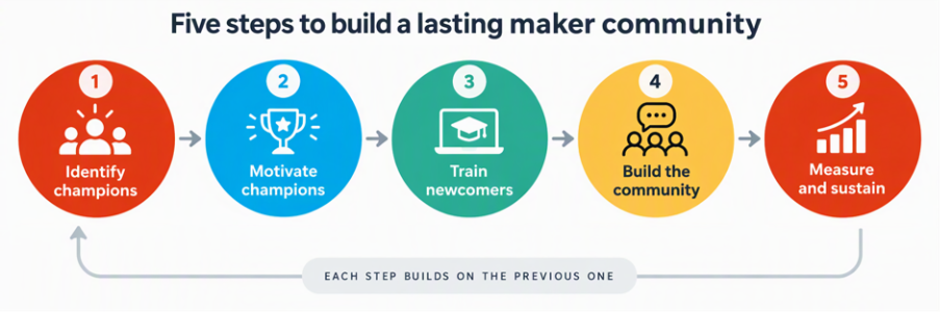
Five steps to build a lasting maker community
Why ELCA ?
ELCA supports organizations at every stage of a Power Platform rollout to business users. We help set up a governance framework and environment strategy that protect the organization without slowing makers down. We work with each business unit to identify and onboard champions, and we accompany them through their first builds. Our trainers design hands-on sessions around your own processes and vocabulary. We also help you launch and run the maker community, from showcase formats to reusable templates. As adoption grows, our experts support the solutions that become business-critical, so that citizen developers and professional developers work together rather than in parallel.
Key takeaways
In short, citizen development becomes sustainable when people are motivated through early wins, trained on problems they already have, and kept engaged by a community that shares and reuses what works. Start with a small group of champions, give them protected time, and make the community visible from the first month, because activity fades quickly without deliberate care.